C A P I T A L
Vol. II

CHAPTER XX.  Simple Reproduction .  .  .  .  .  .  .  .  .  .  .  .

396

I.
II.
III.
IV.

V.
VI.
VII.
VIII.
IX.
X.
XI.


XII.
XIII.

The Formulation of the Question .  .  .  .  .  .  .  .  .  .  .
The Two Departments of Social Production . .  .  .  .  .  .
Exchange Between the Two Departments I(v+s) versus IIc.
Exchange within Department II. Necessities of Life and
Articles of Luxury .  .  .  .  .  .  .  .  .  .  .  .  .  .  .  .  .
The Mediation of Exchange by the Circulation of Money .  .
The Constant Capital of Department I .  .  .  .  .  .  .  .  .
Variable Capital and Surplus-Value in Both Departments .
The Constant Capital in Both Departments .  .  .  .  .  .  .
A Retrospect to Adam Smith, Storch, and Ramsay .  .  .  .
Capital and Revenue: Variable Capital and Wages .  .  .  .
Replacement of the Fixed Capital . .  .  .  .  .  .  .  .  .  .
1. Replacement of the Wear and Tear Portion of the   Value in the Form of Money .  .  .  .  .  .  .  .  .  .  .  .
2. Replacement of Fixed Capital in Kind .  .  .  .  .  .  .  .
3. Results .  .  .  .  .  .  .  .  .  .  .  .  .  .  .  .  .  .  .  .
The Reproduction of the Money Material .  .  .  .  .  .  .  .
Destutt de Tracy's Theory of Reproduction .  .  .  .  .  .  .

396
399
402

406
415
426
429
433
437
441
453

457
462
471
473
484


Prepared © for the Internet by David J. Romagnolo, djr@cruzio.com (May 1997)

    If, for the sake of simplicity, we assume the same proportion between the variable and constant capital (which, by the way, is not at aII necessary), we obtain for 400v (a) a constant capital of 1,600, and for 100v (b) a constant capital of 400. We then have the foIIowing two sub-divisions, a and b, in II:

IIa) 1,600c + 400v + 400s = 2,400 
IIb)    400c + 100v + 100s =    600,
adding up to
2,000c + 500v + 500s = 3,000

    Accordingly 1,600 of the 2,000 IIc in articles of consumption which are exchanged for 2,000 I(v+s), are exchanged for means

page 411

of production of necessities of life and 400 for means of production of luxuries.

    The 2,000 I(v+s) would therefore break up into (800v + 800s) I for a, equal to 1,600 means of production of necessities of life, and (200v + 200s) I for b, equal to 400 means of production of luxuries.

    A considerable part of the instruments of labour as such, as weII as of the raw and auxiliary materials, etc., is the same for both departments. But so far as the exchange of the various portions of value of the total product I(v+s) is concerned, such a division would be whoIIy immaterial. Both the above 800v of I and the 200v of I are realised because the wages are spent for articles of consumption 1,000 IIc; hence the money-capital advanced for this purpose is distributed evenly on its return among the capitalist producers of I, their advanced variable capital is replaced pro rata in money. On the other hand, so far as the realisation of the 1,000 Is is concerned, the capitalists wiII here like wise draw uniformly (in proportion to the magnitude of their s) 600 IIa and 400 IIb in means of consumption out of the entire second half of IIc equal to 1,000; consequently those who replace the constant capital of IIa wiII draw.

    480 (three-fifths) out of 600c (IIa) and 320 (two-fifths) out of 400c (IIb), a total of 800; those who replace the constant capital of IIb wiII draw.

    120 (three-fifths) out of 600c (IIa) and 80 (two-fifths) out of 400c (IIb), which equals 200. Grand total, 1,000.

    What is arbitrary here is the ratio of the variable to the constant capital of both I and II and so is the identity of this ratio for I and II and their sub-divisions. As for this identity, it has been assumed here merely for the sake of simplification, and it would not alter in any way the conditions of the problem and its solution if we were to assume different proportions. However, the necessary result of aII this, on the assumption of simple reproduction, is the foIIowing:

    1) That the new value created by the labour of one year (divisible into v+s) in the bodily form of means of production is equal to the value of the constant capital c contained in the value of the product created by the other part of the annual labour and reproduced in the form of articles of consumption. If it were smaIIer than IIc, it would be impossible for II to replace its constant capital entirely; if it were greater, a surplus would remain unused. In either case, the assumption of simple reproduction would be violated.

page 412

2) That in the case of annual product which is reproduced in the form of articles of consumption, the variable capital v advanced in the form of money can be realised by its recipients inasmuch as they are labourers producing luxuries, only in that portion of the necessities of life which embodies for their capitalist producers prima facie their surplus-value; hence that v, laid out in the production of luxuries, is equal in value to a corresponding portion of s produced in the form of necessities of life, and hence must be smaller than the whole of this s, namely (IIa), and that the variable capital advanced by the capitalist producers of luxuries returns to them in the form of money only by means of the realisation of that v in this portion of s. This phenomenon is quite analogous to the realisation of I(v+s) in IIc, except that in the second case (IIb)v realises itself in a part of (IIa)s of the same value. These proportions remain qualitatively determinant in every distribution of the total annual product, since it actually enters into the process of the annual reproduction brought about by circulation. I(v+s) can be realised only in IIc, just as IIc can only be renewed in function as A component part of productive capital by means of this realisation in the same way, (IIb)v can be realised only in a portion of (IIa)s and (IIb)v can only thus be reconverted into the form of money-capital. It goes without saying that this applies only to the extent that it all is really a result of the process of reproduction itself, i.e., to the extent that the capitalists of IIb, for instance, do not obtain money-capital for v on credit from others. Quantitatively however the exchanges of the various portions of the annual product can take place in the proportions indicated above only so long as the scale and value-relations in production remain stationary and so long as these strict relations are not altered by foreign commerce.

    Now, if we were to say after the manner of Adam Smith that I(v+s) resolve themselves into IIc and IIc resolves itself into I(v+s) or, as he used to say more frequently and still more absurdly, I(v+s) constitute component parts of the price (or value in exchange, as he has it) of IIc and IIc constitutes the entire component part of the value of I(v+s) then one could and should likewise say that (IIb)v resolves itself into (IIa)s, or (IIa)s into (IIb)v, or (IIb)v forms a component part of the surplus-value of IIa, and, vice versa, the surplus-value thus resolves itself into wages, or into variable capital, and the variable capital forms a component part of the surplus-value. This absurdity is indeed found in Adam Smith, since with him wages are de-

page 413

termined by the value of the necessities of life, and these commodity-values in their turn by the value of the wages (variable capital) and surplus-value contained in them. He is so absorbed in the fractional parts into which the value-product of one working-day is divided on the basis of capitalism -- namely into v plus s -- that he quite forgets that it is immaterial in simple commodity exchange whether the equivalents existing in various bodily forms consist of paid or unpaid labour, since their production costs in either case the same amount of labour; and that it is also immaterial whether the commodity of A is a means of production and that of B an article of consumption, and whether one commodity has to serve as a component part of capital after its sale while another passes into the consumption-fund and, secundum Adam, is consumed as revenue. The use to which the individual buyer puts his commodity does not come within the scope of commodity-exchange, the sphere of circulation, and does not affect the value of the commodity. This is in no wise altered by the fact that in the analysis of the circulation of the total annual social product, the definite use for which it is intended, the factor of consumption of the various component parts of that product, must be taken into consideration.

    In the exchange established above of (IIb)v for a portion of (IIa)s of the same value, and in the further exchanges between (IIa)s and (IIb)s it is by no means assumed that either the individual capitalists of IIa and IIb or their respective totalities divide their surplus-value in the same proportion between necessary articles of consumption and articles of luxury. The one may spend more on this consumption, the other more on that. On the basis of simple reproduction it is merely assumed that a sum of values equal to the entire surplus-value is realised in the consumption-fund. The limits are thus given. Within each department the one may spend more in a, the other in b. But this may compensate itself mutually, so that the capitalist groups of a and b, taken as a whole, each participate in the same proportion in both. The value-relations -- the proportional shares of the two kinds of producers, a and b, in the total value of product II -- consequently also a definite quantitative relation between the branches of production supplying those products -- are however necessarily given in each concrete case; only the proportion chosen as an illustration is a hypothetical one. It would not alter the qualitative aspects if another illustration were selected; only the quantitative determinations would be altered. But if on ac-

page 414

count of any circumstances there arises an actual change in the relative magnitude of a and b, the conditions of simple reproduction would also change accordingly.

    Since (IIb)v is realised in an equivalent part of (IIa)s, it follows that in proportion as the luxury part of the annual product grows, as therefore an increasing share of the labour-power is absorbed in the production of luxuries, the reconversion of the variable capital advanced in (IIb)v into money-capital functioning anew as the money-form of the variable capital, and thereby the existence and reproduction of the part of the working-class employed in IIb -- the supply to them of consumer necessities -- depends upon the prodigality of the capitalist class, upon the exchange of a considerable portion of their surplus-value for articles of luxury.

    Every crisis at once lessens the consumption of luxuries. It retards, delays the reconversion of (IIb)v into money-capital, permitting it only partially and thus throwing a certain number of the labourers employed in the production of luxuries out of work, while on the other hand it thus clogs the sale of consumer necessities and reduces it. And this without mentioning the unproductive labourers who are dismissed at the same time, labourers who receive for their services a portion of the capitalists' luxury expense fund (these labourers are themselves pro tanto luxuries), and who take part to a very considerable extent in the consumption of the necessities of life, etc. The reverse takes place in periods of prosperity, particularly during the times of bogus prosperity, in which the relative value of money, expressed in commodities, decreases also for other reasons (without any actual revolution in values), so that the prices of commodities rise independently of their own values. It is not alone the consumption of necessities of life which increases. The working-class (now actively reinforced by its entire reserve army) also enjoys momentarily articles of luxury ordinarily beyond its reach, and those articles which at other times constitute for the greater part consumer "necessities" only for the capitalist class. This on its part calls forth a rise in prices.

    It is sheer tautology to say that crises are caused by the scarcity of effective consumption, or of effective consumers. The capitalist system does not know any other modes of consumption than effective ones, except that of sub forma pauperis or of the swindler. That commodities are unsaleable means only that no effective purchasers have been found for them, i.e., consumers (since commodities are bought in the final analysis for productive or in-

page 415

dividual consumption). But if one were to attempt to give this tautology the semblance of a profounder justification by saying that the working-class receives too small a portion of its own product and the evil would be remedied as soon as it receives a larger share of it and its wages increase in consequence, one could only remark that crises are always prepared by precisely a period in which wages rise generally and the working-class actually gets a larger share of that part of the annual product which is intended for consumption. From the point of view of these advocates of sound and "simple" (!) common sense, such a period should rather remove the crisis. It appears, then, that capitalist production comprises conditions independent of good or bad will, conditions which permit the working-class to enjoy that relative prosperity only momentarily, and at that always only as the harbinger of a coming crisis.[47]

    We saw a while ago that the proportion between the production of consumer necessities and that of luxuries requires the division of II(v+s) between IIa and IIb, and thus of IIc between (IIa)c and (IIb)c. Hence this division affects the character and the quantitative relations of production to their very roots, and is an essential determining factor of its general structure.

    Simple reproduction is essentially directed toward consumption as an end, although the grabbing of surplus-value appears as the compelling motive of the individual capitalists; but surplus-value, whatever its relative magnitude may be, is after all supposed to serve here only for the individual consumption of the capitalist.

    As simple reproduction is a part, and the most important one at that, of all annual reproduction on an extended scale, this motive remains as an accompaniment of and contrast to the self-enrichment motive as such. In reality the matter is more complicated, because partners in the loot -- the surplus-value of the capitalist -- figure as consumers independent of him.


V. THE MEDIATION OF EXCHANGE
BY THE CIRCULATION OF MONEY

    So far as we have analysed circulation up to the present, it proceeded between the various classes of producers as indicated in the following scheme:


    [47] Ad notum for possible followers of the Rodbertian theory of crises. --F. E.
[Transcriber's Note: There is no footnote number "46" in the editions prepared by either Progress Publishers or International Publishers. -- DJR]

page 416

    1) Between class I and class II:

       I.  4,000c + 1,000v + 1,000s
                         ______________ 
      II. .  .  .  .  .           2,000c        .  .  .  .  . + 500v + 500s
      

    This disposes of the circulation of IIc equal to 2,000, which is exchanged for I (1,000v + 1,000s).

    Leaving aside for the present the 4,000 Ic there still remains the circulation of v+s within class II. Now II(v+s) is divided between the sub-classes IIa and IIb in the following manner:

2) II.  500v + 500s = a (400v + 400s) + b (100v + 100s).

    The 400v (a) circulates within its own sub-class; the labourers paid with it buy from their employers, the capitalists IIa, necessary means of subsistence produced by themselves.

    Since the capitalists of both sub-classes spend three-fifths of their surplus-value in products of IIa (necessities) and two-fifths in products of IIb (luxuries), the three-fifths of the surplus-value of a, or 240, are consumed within the sub-class. IIa itself; likewise, two-fifths of the surplus-value of b (produced and existing in the form of articles of luxury), within the sub-class IIb.

    There remains to be exchanged between IIa and IIb: On the side of IIa: 160s;

    On the side of IIb: 100v + 60s. These cancel each other. With their 100, received in the form of money wages, the labourers of IIb buy necessities of life in that amount from IIa. The IIb capitalists likewise buy necessities from IIa to the amount of three-fifths of their surplus-value, or 60. The IIa capitalists thus obtain the money required for investing, as above assumed, two-fifths of their surplus-value, or 160s, in luxuries produced by IIb (100v held by the IIb capitalists as a product replacing the wages paid by them, and 60s). The scheme for this is therefore:

    3) IIa. [400v]   [240s] +      160s
                                        __________ 
           b.   .    .    .    .    .    100v + 60s   + [40s],
    
the bracketed items circulating and being consumed only within their own sub-class.

    The direct reflux of the money-capital advanced in variable capital, which takes place only in the case of the capitalist department IIa which produces necessities of life, is but an expression, modified by special conditions, of the previously mentioned general law that money advanced to the circulation by producers of commodities returns to them in the normal course

page 417

of commodity circulation. From this it incidentally follows that if any money-capitalist at all stands behind the producer of commodities and advances to the industrial capitalist money-capital (in the strictest meaning of the word, i.e., capital-value in the form of money), the real point of reflux for this money is the pocket of this money-capitalist. Thus the mass of the circulating money belongs to that department of money-capital which is organised and concentrated in the form of banks, etc., although the money circulates more or less through all hands. The way in which this department advances its capital necessitates the continual final reflux to it in the form of money, although this is once again brought about by the reconversion of the industrial capital into money-capital.

    The circulation of commodities always requires two things: Commodities which are thrown into circulation and money which is likewise thrown into it. "The process of circulation . . . does not, like direct barter of products, become extinguished upon the use-values changing places and hands. The money does not vanish on dropping out of the circuit of the metamorphosis of a given commodity. It is constantly being precipitated into new places in the arena of circulation vacated by other commodities," etc. (Buch I, Kap. III, p. 92).[*]

    For instance in the circulation between IIc and I(v+s) we assumed that II had advanced £500. in money for it. In the innumerable processes of circulation, into which the circulation between large social groups of producers resolves itself, representatives of the various groups will at various times be the first to appear as buyers, and hence throw money into circulation. Quite apart from particular circumstances, this is necessitated by the difference, if nothing else, in the periods of production, and thus of the turnovers, of the various commodity-capitals. So with these £500 II buys from I means of production of the same value and I buys from II articles of consumption valued at £500. Hence the money flows back to II, but this department does not in any way grow richer by this reflux. It had first thrown £500 in money into circulation and drew commodities of the same value out of it; then it sells £500 worth of commodities and draws the same amount of money out of circulation; thus the £500 flow back to it. As a matter of fact, II has thrown into circulation £500 in money and £500 in commodities, which is equal to £1,000. It draws out of the circulation £500 in commoditles and £500 in


    * English edition: Ch. III, pp. 112-13. --Ed.

page

money. The circulation requires for the handling of £500 in I commodities and £500 in II commodities only £500 in money; hence whoever advanced the money in the purchase of commodities from other producers recovers it when selling his own. Consequently if I had at first bought commodities from II for £500, and later sold to II commodities of the value of £500, these £500 would have returned to I instead of to II.

    In class I the money invested in wages, i.e., the variable capital advanced in the form of money, does not return directly in this form but indirectly, by a detour. But in II the £500 of wages return directly from the labourers to the capitalists, and this return is always direct in the case where purchase and sale take place repeatedly between the same persons in such a way that they are acting alternately as buyers and sellers of commodities. The capitalist of II pays for the labour-power in money; he thereby incorporates labour-power in his capital and assumes the role of an industrial capitalist in relation to his labourers as wage-earners, but does so only by means of this act of circulation, which is for him merely a conversion of money-capital into productive capital. Thereupon the labourer, who in the first instance was a seller, a dealer in his own labour-power, appears in the second instance as a buyer, a possessor of money, in relation to the capitalist, who now acts as a seller of commodities. In this way the capitalist recovers the money invested by him in wages. As the sale of these commodities does not imply cheating, etc., but is an exchange of equivalents in commodities and money, it is not a process by which the capitalist enriches himself. He does not pay the labourer twice, first in money and then in commodities. His money returns to him as soon as the labourer exchanges it for his commodities.

    However, the money-capital converted into variable capital, i.e., the money advanced for wages, plays a prominent role in the circulation of money itself, since the labourers must live from hand to mouth and cannot give the industrial capitalists credit for any length of time. For this reason variable capital must be advanced in the form of money simultaneously at innumerable territorially different points in society at certain short intervals, such as a week, etc. -- in periods of time that repeat themselves rather quickly (and the shorter these periods, the smaller relatively is the total amount of money thrown at one time into circulation through this channel) -- whatever the various periods of turnover of the capitals in the different branches of industry. In every country with a capitalist production the money-capital so

page 419

advanced constitutes a relatively decisive share of the total circulation, the more so as the same money, before its reflux to its point of departure, passes through the most diverse channels and functions as a medium of circulation for countless other businesses.


    Now let us consider the circulation between I(v+s) and IIc from a different angle.

    Capitalists I advance £1,000 in the payment of wages. With this money the labourers buy £1,000 worth of means of subsistence from capitalists II. These in turn buy for the same money means of production from capitalists I. Capitalists I thus get back their variable capital in the form of money, while capitalists II have reconverted one half of their constant capital from the form of commodity-capital into that of productive capital. Capitalists II advance another £500 in money to get means of production from I. The capitalists I spend this money on articles of consumption from II. These £500 thus return to capitalists II. They advance this amount again in order to reconvert the last quarter of their constant capital, converted into commodities into its productive bodily form. This money flows back to I and once more withdraws articles of consumption of the same amount from II. Thus the £500 return to II. The capitalists II are now as before in possession of £500 in money and £2,000 in constant capital, the latter having been newly converted from the form of commodity-capital into that of productive capital. By means of £1,500 a quantity of commodities worth £5,000 has been circulated. Namely: 1) I pays £1,000 to his labourers for their labour-power of the same value; 2) With these same £1,000 the labourers buy means of subsistence from II; 3) With the same money II buys means of production from I, thereby restoring to I variable capital to the amount of £1,000 in the form of money; 4) II buys £500 worth of means of production from I; 5) With the same £500 I buys articles of consumption from II; 6) With the same £500 II buys means of production from I; 7) With the same £500 I buys means of subsistence from II. Thus £500 have returned to II, which had thrown them into circulation besides its £2,000 in commodities and for which it did not withdraw from circulation any equivalent in commodities.[48]

    The exchange therefore takes the following course:


    [48] This presentation differs somewhat from that given on p. 394 [present volume, pp. 404-05]. There I likewise throws an independent amount of £500 into circulation. Here II alone supplies the additional money for the circulation. But this does not alter the final result. --F. E.

page 420

    1) I pays £1,000 in money for labour-power, hence for commodities equal to £1,000.

    2) The labourers buy with their wages amounting in money to £1,000 articles of consumption from II; hence commodities equal to £1,000.

    3) With the £1,000 received from the labourers II buys means of production of the same value from I; hence commodities equal to £1,000.

    In this way the £1,000 have returned to I as the money-form of its variable capital.

    4) II buys £500 worth of means of production from I, hence commodities equal to £500.

    5) With the same £500 I buys articles of consumption from II; hence commodities equal to £500.

    6) With the same £500 II buys means of production from I; hence commodities equal to £500.

    7) With the same £500 I buys articles of consumption from II; hence commodities equal to £500.

    Total amount of commodity-values exchanged: £5,000.

    The £500 advanced by II for the purchase have returned to it.

    The result is as follows:

    1) I possesses variable capital in the form of money to the amount of £1,000, which it originally advanced to the circulation. It furthermore expended £1,000 for its individual consumption, in the shape of its own products; i.e., it has spent the money which it had received for the sale of means of production to the amount of £1,000.

    On the other hand the bodily form into which the variable capital existing in the form of money must be transformed, i.e., labour-power, has been maintained, reproduced and again made available by consumption as the sole article of trade of its owners, which they must sell in order to live. The relation of wage-labourers and capitalists has likewise been reproduced.

    2) The constant capital of II is replaced in kind, and the £500 advanced by the same II to the circulation have returned to it.

    As for the labourers I, the circulation is the simple one of C--M--C: see [¥] ] (labour-power)-- (£1,000, money-form of variable capital I)-- (necessities of life to the amount of £1,000); these £1,000 convert into money to the same amount of value the constant capital II existing in the form of commodities, of means of subsistence.


    [¥] [Transcribers Note for those without a graphic browser: In the text the expression is "C (labour-power)--M (£1,000, money-form of variable capital I)--C (necessities of life to the amount of £1,000)" and includes the following symbolic notation: above the first C is a small bowl- or crater-like arc with the number 1 placed above it; the M has the same symbol with a 2; and the last C, a 3. -- DJR]

page 421

As for the capitalists II, the process is C--M, the transformation of a portion of their commodity-product into the money-form, from which it is reconverted into the constituents of productive capital, namely into a portion of the means of production required by them.

    In the money advance (£500) made by capitalists II for the purchase of the other parts of the means of production, the money-form of that portion of IIc which exists as yet in the form of commodities (articles of consumption) is anticipated; in the act M--C, in which II buys with M, and C is sold by I, the money (II) is converted into a portion of the productive capiial, while C (I) passes through the act C--M, changes into money, which however does not represent any component part of capital-value for I, but surplus-value converted into money and expended solely for articles of consumption.

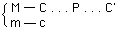
    In the circuit M--C . . . P . . . C'--M', the first act, M--C, is that of one capitalist, the last, C'--M' (or part of it), is that of another; whether the C, by which M is converted into productive capital, represents a component of constant capital, of variable capital, or surplus-value for the seller of C (who exchanges this C for money), is wholly immaterial for the commodity circulation itself.

    Class I, so far as concerns the component v+s of its commodity product, draws more money out of the circulation than it has thrown in. In the first place, the £1,000 of variable capital return to it; in the second place, it sells means of production worth £500 (see above, exchange No. 4); one half of its surplus-value is thus turned into money; then (exchange No. 6) it sells once more £500 worth of means of production, the second half of its surplus-value, and thus the entire surplus-value is withdrawn from circulation in the shape of money. Hence in succession: 1) variable capital reconverted into money, equal to £1,000; 2) one half of the surplus-value turned into money, equal to £500; 3) the other half of the surplus-value, equal to £500; altogether 1,000v + 1,000s turned into money, equal to £2,000. Although I threw only £1,000 into circulation (aside from those exchanges which promote the reproduction of Ic and which we shall have to analyse later), it has withdrawn double that amount from it. Of course s passes into other hands, (II), as soon as it has been converted into money, by being spent for articles of consumption. The capitalists of I withdrew only as much in money as they threw into it in value in the form of commodities; the fact that this value is surplus-value, i.e., that it does not cost

page 422

the capitalists anything, does not alter the value of these commodities in any way; so far as the exchange of values in commodity circulation is concerned, that fact is of no consequence at all. The existence of surplus-value in money is of course transient, the same as all other forms which the advanced capital assumes in its metamorphoses. It lasts no longer than the interval between the conversion of commodities I into money and the subsequent conversion of the money I into commodities II.

    If the turnovers had been assumed to be shorter -- or, from the point of view of the simple circulation of commodities, the circulation of money more rapid -- even less money would be ample to circulate the exchanged commodity-values; the amount is always determined -- if the number of successive exchanges is given -- by the sum of the prices, or the sum of values, of the circulating commodities. It is immaterial in what proportion this sum of values consists of surplus-value on the one hand, and of capital-value on the other.

    If the wages of I, in our illustration, were paid four times per year, we should have 4 times 250, or 1,000. Hence £250 in money would suffice for the circulation Iv -- l/2 IIc, and for that between the variable capital Iv and the labour-power I. Likewise, if the circulation between Is and IIc were to take place in four turnovers, it would require only £250, or in the aggregate a sum of money, or a money-capital, of £500 for the circulation of commodities amounting to £5,000. In that case the surplus-value would be converted into money four times successively, one-quarter each time, instead of twice successively, one half each time.

    If I instead of II should act as buyer in exchange No. 4 and expend £500 for articles of consumption of the same value, II would buy means of production with the same £500 in exchange No. 5; 6) I buys articles of consumption with the same £500; 7) II buys means of production with the same £500 so that the £500 finally return to I, the same as before to II. The surplus-value is here converted into money by means of the money spent by the capitalist producers themselves for their individual consumption. This money represents the anticipated revenue, the anticipated receipts from the surplus-value contained in the commodities still to be sold. The surplus-value is not converted into money by the reflux of the £500; for aside from £1,000 in the form of commodities Iv, I threw £500 in money into circulation at the close of exchange No. 4, and this was additional money, so far as we know, and not the proceeds from the sale of

page 423

commodities. If this money flows back to I, I merely gets back its additional money, and does not thereby convert its surplus-value into money. The conversion of the surplus-value I into money takes place only by the sale of the commodities Is, in which it is incorporated, and lasts each time only until the money obtamed by the sale of the commodities is expended anew in the purchase of articles of consumption.

    With additional money (£500) I buys articles of consumption from II; this money was spent by I, which holds its equivalent in II commodities; the money returns for the first time by the purchase from I by II of commodities to the amount of £500; in other words, it returns as the equivalent of the commodities sold by I, but these commodities do not cost I anything, they constitute surplus-value for I, and thus the money thrown into circulation by this very department turns its own surplus-value into money. On buying for the second time (No. 6) I has likewise obtained its equivalent in II commodities. Take it, now, that II does not buy (No. 7) means of production from I. In that case I would have actually paid £1,000 for articles of consumption, thereby consuming its entire surplus-value as revenue; namely, 500 in its own I commodities (means of production) and 500 in money: on the other hand, it would still have £500 in its own commodities (means of production) in stock, and would have got rid of £500 in money.

    On the contrary II would have reconverted three-fourths of its constant capital from the form of commodity-capital into that of productive capital; but one-fourth (£500) would be held by it in the form of money-capital, actually in the form of idle money, or of money which has suspended its function and is held in abeyance. Should this state of affairs last for any length of time, II would have to cut down its scale of reproduction by one-fourth.

    However the 500 in means of production, which I has on its hands, are not surplus-value existing in the form of commodities, they occupy the place of the £500 advanced in money, which I possessed aside from its £1,000 of surplus-value in commodity-form. In the form of money, they are always convertible; as commodities they are momentarily unsaleable. So much is evident: that simple reproduction -- in which every element of productive capital must be replaced in both II and I -- remains possible in this case only if the 500 golden birds, which I first sent flying, return to it.

    If a capitalist (we have only industrial capitalists still to

page 424

deal with here, who are the representatives of all others) spends money for articles of consumption, he is through with it, it goes the way of all flesh. It can flow back to him only if he fishes it out of circulation in exchange for commodities, i.e., for his commodity-capital. As the value of his entire annual commodity-product (his commodity-capital), so that of every one of its elements, i.e., the value of every individual commodity, is divisible, as far as he is concerned, into constant capital-value, variable capital-value, and surplus-value. The conversion into money of every individual commodity (as elements constituting the commodity-product) is consequently at the same time such a conversion of a certain portion of the surplus-value contained in the entire commodity-product. In this case, then, it is literally true that the capitalist himself threw the money into circulation -- when he spent it on articles of consumption -- by which his surplus-value is converted into money, or realised. Of course it is not a question of the identical coins but of a certain amount of hard cash equal to the one (or to a portion of the one) which he had previously thrown into circulation to satisfy his personal wants.

    In practice this occurs in two ways: If the business has just been opened, in the current year, it will take quite a while, at least a few months, before the capitalist is able to use any portion of the receipts of his business for his personal consumption. But for all that he does not suspend his consumption for a single moment. He advances to himself (immaterial whether out of his own pocket or by means of credit from the pocket of somebody else) money in anticipation of surplus-value still to be snatched by him; but in doing so he also advances a circulating medium for the realisation of surplus-value to be realised later. If, on the contrary, the business has been running regularly for a longer period payments and receipts are distributed over different terms throughout the year. But one thing continues uninterruptedly, namely, the consumption of the capitalist, which anticipates, and whose volume is computed on a definite proportion of, the customary or estimated revenue. With every portion of commodities sold, a portion of the surplus-value to be produced annually is also realised. But if during the entire year only as much of the produced commodities is sold as is required to replace the constant and variable capital-values contained in them, or if prices were to fall to such an extent that only the advanced capital-value contained in the entire annual commodity-product should be realised on its sale, then the anticipatory character of the expend-

page 425

iture of money in expectation of future surplus-value would be clearly revealed. If our capitalist fails, his creditors and the court investigate whether his anticipated private expenditures were in proper proportion to the volume of his business and to the receipt of surplus-value usually or normally corresponding to it.

    So far as the entire capitalist class is concerned, the proposition that it must itself throw into circulation the money required for the realisation of its surplus-value (correspondingly also for the circulation of its capital, constant and variable) not only fails to appear paradoxical, but stands forth as a necessary condition of the entire mechanism. For there are here only two classes: the working-class disposing only of its labour-power, and the capitalist class, which has a monopoly of the social means of production and money. It would rather be a paradox if the working-class were to advance in the first instance from its own resources the money required for the realisation of the surplus-value contained in the commodities. But the individual capitalist makes this advance only by acting as a buyer, expending money in the purchase of articles of consumption or advancing money in the purchase of elements of his productive capital, whether of labour-power or means of production. He never parts with his money unless he gets an equivalent for it. He advances money to the circulation only in the same way as he advances commodities to it. He acts in both instances as the initial point of their circulation.

    The actual process is obscured by two circumstances:

    1) The appearance in the process of circulation of industrial capital of merchant's capital (the first form of which is always money, since the merchant as such does not create any "product" or "commodity") and of money-capital as an object of manipulation by a special kind of capitalists.

    2) The division of surplus-value -- which must always be first in the hands of the industrial capitalist -- into various categories, as vehicles of which there appear, aside from the industrial capitalist, the landlord (for ground-rent), the usurer (for interest), etc., furthermore the government and its employees, rentiers, etc. These gentry appear as buyers vis-à-vis the industrial capitalist and to that extent as converters of his commodities into money; they too throw "money" pro parte into the circulation and he gets it from them. But it is always forgotten from what source they derived it originally, and continue deriving it ever anew.

page 426

VI. THE CONSTANT CAPITAL
0F DEPARTMENT I
[
48a]

    It remains for us to analyse the constant capital of department I, amounting to 4,000c. This value is equal to the value -- appearing anew in the commodity-product I -- of the means of production consumed in the creation of this quantity of commodities. This re-appearing value, which was not produced in the process of production of I, but entered into it during the preceding year as constant value, as the given value of its means of production, exists now in the entire part of commodity mass I not absorbed by category II. And the value of this quantity of commodities thus left in the hands of the I capitalists equals two-thirds of the value of their entire annual commodity-product. In the case of the individual capitalist producing some particular means of production we could say: He sells his commodity-product; he converts it into money. By converting it into money he has also reconverted into money the constant portion of the value of his product. With this portion of value converted into money he then buys his means of production once more from other sellers of commodities or transforms the constant portion of the value of his product into a bodily form in which it can resume its function of productive constant capital. But now this assumption becomes impossible. The capitalist class of I comprises the totality of the capitalists producing means of production. Besides, the commodity-product of 4,000, which is left on their hands, is a portion of the social product which cannot be exchanged for any other, because no such other portion of the annual product remains. With the exception of these 4,000, all the remainder has been disposed of. One portion has been absorbed by the social consumption-fund, and another portion has to replace the constant capital of department II, which has already exchanged everything it could dispose of in an exchange with department I.

    The difficulty is solved very easily if we remember that the entire commodity-product I in its bodily form consists of means of production, i.e., of the material elements of the constant capital itself. We meet here the same phenomenon which we witnessed before under II, only in a different aspect. In the case of II the entire commodity-product consisted of articles of consumption. Hence one portion of it, measured by the wages plus surplus-value contained in this product, could be consumed by its


    [48a] From here, Manuscript II. --F. E.

page 427

own producers. Here, in the case of I, the entire product consists of means of production, of buildings, machinery, vessels, raw and auxiliary materials, etc. One portion of them, namely that replacing the constant capital employed in this sphere, can therefore immediately function anew in its bodily form as a component of the productive capital. So far as it goes into circulation, it circulates within class I. In II a part of the commodity-product is individually consumed in kind by its own producers while in I a portion of the product is productively consumed in kind by its capitalist producers.

    In the part of the commodity-product I equal to 4,000c the constant capital-value consumed in this category re-appears, and does so in a bodily form in which it can immediately resume its function of productive constant capital. In II that portion of the commodity-product of 3,000 whose value is equal to the wages plus the surplus-value (equal to 1,000) passes directly into the individual consumption of the capitalists and labourers of II, while on the other hand the, constant capital-value of this commodity-product (equal to 2,000) cannot re-enter the productive consumption of the II capitalists but must be replaced by exchange with I.

    In I, on the contrary, that portion of its commodity-product of 6,000 whose value is equal to the wages plus the surplus-value (equal to 2,000) does not pass into the individual consumption of its producers, and cannot do so on account of its bodily form. It must first be exchanged with II. Contrariwise the constant portion of the value of this product, equal to 4,000, exists in a bodily form in which -- taking the capitalist class I as a whole -- it can immediately resume its function of constant capital of that class. In other words, the entire product of department I consists of use-values which, on account of their bodily form, can under a capitalist mode of production serve only as elements of constant capital. Hence one-third (2,000) of this product of 6,000 replaces the constant capital of department II, and the other two-thirds the constant capital of department I.

    The constant capital I consists of a great number of different groups of capital invested in the various branches of production of means of production, so much in iron works, so much in coal-mines, etc. Every one of these groups of capital, or every one of these social group capitals, is in its turn composed of a larger or smaller number of independently functioning individual capitals. In the first place, the capital of society, for instance 7,500 (which may mean millions, etc.) is composed of various groups of capital;

page 428

the social capital of 7,500 is divided into separate parts, every one of which is invested in a special branch of production; each portion of the social capital-value invested in some particular branch of production consists, so far as its bodily form is concerned, partly of means of production required in that particular sphere of production, partly of the labour-power needed in that business and trained accordingly, variously modified by division of labour, according to the specific kind of labour to be performed in each individual sphere of production. Each portion of social capital invested in any particular branch of production in its turn consists of the sum of the individual capitals invested in it and functioning independently. This patently applies to both departments, I as well as II.

    As for the constant capital-value re-appearing in I in the form of its commodity-product, it re-enters in part as means of production into the particular sphere of production (or even into the individual business) from which it emerges as product; for instance corn into the production of corn, coal into the production of coal, iron in the form of machines into the production of iron, etc.

    However since the partial products constituting the constant capital-value I do not return directly to their particular or individual sphere of production, they merely change their place. They pass in their bodily form to some other sphere of production of department I, while the product of other spheres of production of department I replaces them in kind. It is merely a change of place of these products. All of them re-enter as factors replacing constant capital in I, only instead of the same group of I they enter another. Since an exchange takes place here between the individual capitalists of I, it is an exchange of one bodily form of constant capital for another bodily form of constant capital, of one kind of means of production for other kinds of means of production. It is an exchange of the different individual parts of constant capital I among themselves. Products which do not serve directly as means of production in their own sphere are transferred from their place of production to another and thus mutually replace one another. In other words (similarly to what we saw in the case of the surplus-value II), every capitalist I draws from this quantity of commodities, proportionally to his share in the constant capital of 4,000, the means of production required by him. If production were socialised instead of capitalistic, these products of department I would evidently just as regularly be redistributed as means of production to the various branches

page 429

of this department, for purposes of reproduction, one portion remaining directly in that sphere of production from which it emerged as a product, another passing over to other places of production, thereby giving rise to a constant to-and-fro movement between the various places of production in this department.


VII. VARIABLE CAPITAL AND SURPLUS-VALUE
IN BOTH DEPARTMENTS

    The total value of the annually produced articles of consumption is thus equal to the variable capital-value II reproduced during the year plus the newly produced surplus-value II (i.e., equal to the value produced by II during the year) plus the variable capital-value I reproduced during the year and the newly produced surplus-value I (i.e., plus the value created by I during the year).

    On the assumption of simple reproduction the total value of the annually produced articles of consumption is therefore equal to the annual value-product, i.e., equal to the total value produced during the year by social labour, and this must be so, because in simple reproduction this entire value is consumed.

    The total social working-day is divided into two parts: 1) Necessary labour which creates in the course of the year a value of 1,500v; 2) surplus-labour, which creates an additional value, or surplus-value, of 1,500s. The sum of these values, 3,000, is equal to the value of the annually produced articles of consumption -- 3,000. The total value of the articles of consumption produced during the year is therefore equal to the total value produced by the total social working-day during the year, equal to the value of the social variable capital plus the social surplus-value, equal to the total new product of the year.

    But we know that although these two magnitudes of value are equal the total value of commodities II, the articles of consumption, is not produced in this department of social production. They are equal because the constant capital-value re-appearing in II is equal to the value newly produced by I (value of variable capital plus surplus-value); therefore I(v+s)can buy the part of the product of II which represents the constant capital-value for its producers (in department II). This shows, then, why the value of the product of capitalists II, from the point of view of society, may be resolved into v+s although for

page 430

these capitalists it is divided into c+v+s. This is so only because IIc is here equal to I(v+s), and because these two components of the social product interchange their bodily forms by exchange so that after this transformation IIc exists once more in means of production and I(v+s) in articles of consumption.

    And it is this circumstance which induced Adam Smith to maintain that the value of the annual product resolves itself into v+s. This is true 1) only for that part of the annual product which consists of articles of consumption; and 2) it is not true in the sense that this total value is produced in II and that the value of its product is equal to the value of the variable capital advanced in II plus the surplus-value produced in II. It is true only in the sense that II(c+v+s) is equal to II(v+s) + I(v+s) or because IIc is equal to I(v+s).

    It follows furthermore:

    The social working-day (i.e., the labour expended by the entire working-class during the whole year), like every individual working-day, breaks up into only two parts, namely into necessary labour and surplus-labour, and the value produced by this working-day consequently likewise resolves itself into only two parts, namely into the value of the variable capital, or that portion of the value with which the labourer buys the means of his own reproduction, and the surplus-value which the capitalist may spend for his own individual consumption. Nevertheless, from the point of view of society, one part of the social working-day is spent exclusively on the production of new constant capital, namely of products exclusively intended to function as means of production in the labour-process and hence as constant capital in the accompanying process of self-expansion of value. According to our assumption the total social working-day presents itself as a money-value of 3,000, only one-third of which, or 1,000, is produced in department II, which manufactures articles of consumption, that is, the commodities in which the entire value of the variable capital and the entire surplus-value of society are ultimately realised. Thus, according to this assumption, two-thirds of the social working-day are employed in the production of new constant capital. Although from the standpoint of the individual capitalists and labourers of department I these two-thirds of the social working-day serve merely for the production of variable capital-value plus surplus-value, the same as the last third of the social working-day in department II, still from the point of view of society and likewise of the use-value of the product, these two-thirds of the social working-day produce

page 431

only replacement of constant capital in the process of productive consumption or already so consumed. Also when viewed individually these two-thirds of the working-day, while producing a total value equal only to the value of the variable capital plus surplus-value for the producer, nevertheless do not produce any use-values of a kind on which wages or surplus-value could be expended; for their products are means of production.

    It must be noted in the first place that no portion of the social working-day, whether in I or in II, serves for the production of the value of the constant capital employed and functioning in these two great spheres of production. They produce only additional value, 2,000 I(v+s) + 1,000 II(v+s), in addition to the value of the constant capital equal to 4,000 Ic + 2,000 IIc. The new value produced in the form of means of production is not yet constant capital. It merely is intended to function as such in the future.

    The entire product of II -- the articles of consumption -- viewed concretely as a use-value, in its bodily form, is a product of the one-third of the social working-day spent by II. It is the product of labour in its concrete form -- such as the labour of weaving, baking, etc., performed in this department -- the product of this labour, inasmuch as it functions as the subjective element of the labour-process. As to the constant portion of the value of this product II, it re-appears only in a new use-value, in a new bodily form, the form of articles of consumption, while it existed previously in the form of means of production. Its value has been transferred by the labour-process from its old bodily form to its new bodily form. But the value of these two-thirds of the product-value, equal to 2,000, has not been produced in this year's self-expansion process of II.

    Just as from the point of view of the labour-process, the product of II is the result of newly functioning living labour and of the assumed means of production assigned to it, in which that labour materialises itself as in its objective conditions, so, from the point of view of the process of self-expansion, the value of the product of II, equal to 3,000, is composed of a new value (500v + 500s =1,000) produced by the newly added one-third of the social working-day and of a constant value in which are embodied two-thirds of a past social working-day that had elapsed before the present process of production of II here under consideration. This portion of the value of the II product finds expression in a portion of the product itself. It exists in a quantity of articles of consumption worth 2,000, or two-thirds of

page 432

a social working-day. This is the new use-form in which this value-portion re-appears. The exchange of part of the articles of consumption equal to 2,000 IIc for means of production of I equal to I (1,000v + 1,000s) thus really represents an exchange of two-thirds of an aggregate working-day -- which do not constitute any portion of this year's labour, and elapsed before this year -- for two-thirds of the working-day newly added this year. Two-thirds of this year's social working-day could not be employed in the production of constant capital and at the same time constitute variable capital-value plus surplus-value for their own producers unless they were to be exchanged for a portion of the value of the annually consumed articles of consumption in which are incorporated two-thirds of a working-day spent and realised before this year. It is an exchange of two-thirds of this year's working-day for two-thirds of a working-day spent before this year, an exchange of this year's labour-time for last year's. This explains the riddle of how the value-product of an entire social working-day can resolve itself into variable capital-value plus surplus-value, although two-thirds of this working-day were not expended in the production of articles in which variable capital or surplus-value can be realised, but rather in the production of means of production for the replacement of the capital consumed during the year. The explanation is simply that two-thirds of the value of the product of II, in which the capitalists and labourers of I realise the variable capital-value plus surplus-value produced by them (and which constitute two-ninths of the value of the entire annual product), are, so far as their value is concerned, the product of two-thirds of a social working-day of a year prior to the current one.

    The sum of the social product I and II -- means of production and articles of consumption -- is indeed, viewed from the stand-point of their use-value, in their concrete, bodily form, the product of this year's labour, but only to the extent that this labour itself is regarded as useful and concrete and not as an expenditure of labour-power, as value-creating labour. And even the first is true only in the sense that the means of production have transformed themselves into new products, into this year's products solely by dint of the living labour added on to them, operating on them. On the contrary, this year's labour could not have transformed itself into products without means of production independent of it, without instruments of labour and materials of production.

page 433


VIII. THE CONSTANT CAPITAL IN BOTH DEPARTMENTS

    The analysis of the total value of the product of 9,000, and of the categories into which it is divided, does not present any greater difficulty than that of the value produced by an individual capital. On the contrary, they are identical.

    The entire annual social product here contains three social working-days, each of one year. The value expressed by each one of these working-days is 3,000, so that the value expressed by the total product is equal to 3 x 3,000, or 9,000.

    Furthermore the following portions of this working time have elapsed prior to the one-year process of production, the product of which we are now analysing: In department I four-thirds of a working-day (with a product worth 4,000), and in department II two-thirds of a working-day (with a product worth 2,000), making a total of two social working-days with a product worth 6,000. For this reason 4,000 Ic + 2,000 IIc = 6,000c figure as the value of the means of production, or the constant capital-value re-appearing in the total value of the social product.

    Furthermore one-third of the social working-day of one year newly added in department I is necessary labour, or labour replacing the value of the variable capital of 1,000 Iv and paying the price of the labour employed by I. In the same way one-sixth of a social working-day in II is necessary labour with a value of 500. Hence 1,000 Iv + 500 IIv = 1,500v, expressing the value of one half of the social working-day, is the value-expression of the first half of the aggregate working-day added this year and consisting of necessary labour.

    Finally, in department I one-third of the aggregate working-day, with a product worth 1,000, is surplus-labour, and in department II one-sixth of the working-day, with a product worth 500, is surplus-labour. Together they constitute the other half of the added aggregate working-day. Hence the total surplus value produced is equal to 1,000 Is + 500 IIs, or 1,500s.

    Thus:

    The constant capital portion of the value of the social product (c):

    Two working-days expended prior to the process of production; expression of value = 6,000.

    Necessary labour (v) expended during the year:

    One half of a working-day expended on the annual production; expression of value = 1,500.

    Surplus-labour (s) expended during the year:

page 434

    One half of a working-day expended on the annual production; expression of value = 1,500.

    Value produced by annual labour (v+s) = 3,000.

    Total value of product (c+v+s) = 9,000.

    The difficulty, then, does not consist in the analysis of the value of the social product itself. It arises in the comparison of the component parts of the value of the social product with its material constituents.

    The constant, merely re-appearing portion of value is equal to the value of that part of this product which consists of means of production and is incorporated in that part.

    The new value-product of the year, equal to v+s, is equal to the value of that part of this product which consists of articles of consumption and is incorporated in it.

    But with exceptions of no consequence here, means of production and articles of consumption are wholly different kinds of commodities, products of entirely different bodily or use-forms, and, therefore, products of wholly different classes of concrete labour. The labour which employs machinery in the production of means of subsistence is vastly different from the labour which makes machinery. The entire aggregate annual working-day, whose value-expression is 3,000, seems spent in the production of articles of consumption equul to 3,000, in which no constant portion of value re-appears, since these 3,000, equal to 1,500v + 1,500s, resolve themselves only into variable capital-value and surplus-value. On the other hand the constant capital-value of 6,000 re-appears in a class of products quite different from articles of consumption, namely in means of production, while as a matter of fact no part of the social working-day seems spent in the production of these new products. It seems rather that the entire working-day consists only of classes of labour which do not result in means of production but in articles of consumption. This mystery has already been cleared up. The value-product of the year's labour is equal to the value of the products of department II, to the total value of the newly produced articles of consumption. But the value of these products is greater by two-thirds than that portion of the annual labour which has been expended in the sphere of production of articles of consumption (department II). Only one-third of the annual labour has been expended in their production. Two-thirds of this annual labour have been expended in the production of means of production, that is to say, in department I. The value-product created during this time in I, equal to the variable capital-value plus surplus-value pro-

page 435

duced in I, is equal to the constant-capital-value of II re-appearing in articles of consumption of II. Hence they may be mutually exchanged and replaced in kind. The total value of the articles of consumption of II is therefore equal to the sum of the new value-product of I and II, or II(c+v+s) is equal to I(v+s) + II(v+s), hence equal to the sum of the new values produced by the year's labour in the form of v plus s.

    On the other hand the total value of the means of production (I) is equal to the sum of the constant capital-value re-appearing in the form of means of production (I) and in that of articles of consumption (II); in other words, equal to the sum of the constant capital-value re-appearing in the total product of society. This total value is equal in terms of value to four-thirds of a working day preceding the process of production of I and two-thirds of a working-day preceding the process of production of II, in all equal to two aggregate working-days.

    The difficulty with the annual social product arises therefore from the fact that the constant portion of value is represented by a wholly different class of products -- means of production -- than the new value v+s added to this constant portion of value and represented by articles of consumption. Thus the appearance is created, so far as value is concerned, that two-thirds of the consumed mass of products are found again in a new form as new product, without any labour having been expended by society in their production. This is not so in the case of an individual capital. Every individual capitalist employs some particular concrete kind of labour, which transforms the means of production peculiar to it into a product. Let for instance the capitalist be a machine-builder, the constant capital expended during the year 6,000c, the variable 1,500v, the surplus-value 1,500s, the product 9,000, the product, say, 18 machines of 500 each. The entire product here exists in the same form, that of machines. (If he produces various kinds, each kind is calculated separately.) The entire commodity-product is the result of the labour expended during the year in machine-building; it is a combination of the same concrete kind of labour with the same means of production. The various portions of the value of the product therefore present themselves in the same bodily form: 12 machines embody 6,000c, 3 machines 1,500v, 3 machines 1,500s. In the present case it is evident that the value of the 12 machines is equal to 6,000c, not because there is incorporated in these 12 machines only labour performed previously to the manufacture of these machines and not labour expended on build-

page 436

ing them. The value of the means of production for 18 machines did not of itself become transformed into 12 machines but the value of these 12 machines (consisting itself of 4,000c + 1,000v + 1,000s) is equal to the total value of the constant capital contained in the 18 machines. The machine-manufacturer must therefore sell 12 of the 18 machines in order to replace his expended constant capital, which he requires for the reproduction of 18 new machines. On the contrary, the thing would be inexplicable if in spite of the fact that the labour expended was employed solely in the manufacture of machines, the result were to be: On the one hand 6 machines equal to 1,500v + 1,500s, on the other iron, copper, screws, belts, etc., of a value amounting to 6,000c, i.e., the means of production of the machines in their bodily form, which, as we know, the individual machine-building capitalist does not produce himself but must replace by way of the process of circulation. And yet it seems at first glance that the reproduction of the annual product of society takes place in this absurd way.

    The product of an individual capital, i.e., of every fraction of the social capital endowed with a life of its own and functioning independently, has a bodily form of one kind or another. The only condition is that this product must really have a use-form, a use-value, which gives it the imprint of a member of the world of commodities capable of circulation. It is immaterial and accidental whether or not it can re-enter as a means of production into the same process of production from which it emerged as a product; in other words, whether the portion of its value representing the constant part of the capital has a bodily form in which it can actually function again as constant capital. If not, this portion of the value of the product is reconverted into the form of its material elements of production by means of sale and purchase and thus the constant capital is reproduced in the bodily form capable of functioning.

    It is different with the product of the aggregate social capital. All the material elements of reproduction must in their bodily form constitute parts of this product. The consumed constant part of capital can be replaced by the aggregate production only to the extent that the entire constant part of the capital re-appearing in the product re-appears in the bodily form of new means of production which can really function as constant capital. Hence, simple reproduction being assumed, the value of that portion of the product which consists of means of production must be equal to the constant portion of the value of social capital.

page 437

    Furthermore: Considered individually, the capitalist produces in the value of his product by means of the newly added labour only his variable capital plus surplus-value, while the constant part of the value is transferred to the product owing to the concrete character of the newly added labour.

    Considered socially that portion of the social working-day which produces means of production, hence adding new value to them as well as transferring to them the value of the means of production consumed in their manufacture, creates nothing but new constant capital intended to replace that consumed in the shape of old means of production in both departments I and II. It creates only product intended for productive consumption. The entire value of this product, then, is only value which can function anew as constant capital, which can only buy back constant capital in its bodily form, and which, for this reason, resolves itself, considered socially, neither into variable capital nor surplus-value.

    On the other hand that part of the social working-day which produces articles of consumption does not create any portion of the social replacement capital. It creates only products intended, in their bodily form, to realise the value of the variable capital and surplus-value of I and II.

    Speaking of the point of view of society, and therefore considering the aggregate product of society, which comprises both the reproduction of social capital and individual consumption, we must not lapse into the manner copied by Proudhon from bourgeois economy and look upon this matter as though a society with a capitalist mode of production, if viewed en bloc, as a totality, would lose this its specific historical and economic character. No, on the contrary. We have, in that case, to deal with the aggregate capitalist. The aggregate capital appears as the capital stock of all individual capitalists combined. This joint-stock company has in common with many other stock companies that everyone knows what he puts in, but not what he will get out of it.


IX. A RETROSPECT TO ADAM SMITH,
STORCH, AND RAMSAY

    The aggregate value of the social product amounts to 9,000, equal to 6,000c + 1,500v + 1,300s, i.e., 6,000 reproduce the value of the means of production and 3,000 that of the articles of con-

page 438

sumption. The value of the social revenue (v+s) amounts therefore to only one-third of the value of the aggregate product, and the totality of consumers, labourers as well as capitalists, can draw commodities, products out of the total social product and incorporate them in their consumption-fund only to the amount of this one-third. On the other hand 6,000, or two-thirds, of the value of the product, are the value of the constant capital which must be replaced in kind. Means of production to this amount must therefore again be incorporated in the production-fund. Storch recognised this as essential without being able to prove it: "It is clear that the value of the annual product is divided partly into capital and partly into profits, and that each one of these portions of the value of the annual product is regularly employed in buying the products which the nation needs both for the maintenance of its capital and for replenishing its consumption-fund. . . . The products which constitute the capital of a nation are not to be consumed." (Storch, Considèrations sur la nature du revenu national, Paris, 1824, pp. 134-35, 150.)

    Adam Smith, however, has promulgated this astounding dogma, which is believed to this day, not only in the previously mentioned form, according to which the entire value of the social product resolves itself into revenue, into wages plus surplus-value, or, as he expresses it, into wages plus profit (interest) plus ground-rent, but also in the still more popular form, according to which the consumers must "ultimately" pay to the producers the entire value of the product. This is to this day one of the best-established commonplaces, or rather eternal truths, of the so-called science of political economy. This is illustrated in the following plausible manner: Take any article, for instance, a linen shirt. First, the spinner of linen yarn has to pay the flax-grower the entire value of the flax, i.e., the value of flax-seed, fertilisers, labouring cattle feed, etc., plus that part of the value which the fixed capital, such as buildings, agricultural implements, etc., of the flax-grower gives up to the product; the wages paid in the production of the flax; the surplus-value (profit, ground-rent) embodied in the flax; finally the carriage costs of the flax from its place of production to the spinnery. Next, the weaver has to reimburse the spinner of the linen yarn not only for the price of the flax, but also for that portion of the value of machinery, buildings, etc., in short of the fixed capital, which is transferred to the flax; furthermore, all the auxiliary materials consumed in the spinning process, the wages of the spinners, the surplus-value, etc., and so the thing goes on with

page 439

the bleacher, the transportation costs of the finished linen, and finally the shirtmaker, who has to pay the entire price of all preceding producers, who supplied him only with his raw material. In his hands a further addition of value takes place, partly through the value of constant capital consumed in the manufacture of shirts in the shape of instruments of labour, auxiliary materials, etc., and partly through the labour expended, which adds the value of the shirtmakers' wages plus the surplus-value of the shirt manufacturer. Now let this entire product in shirts cost ultimately £100 and let this be the aliquot part of the value of the total annual product expended by society on shirts. The consumers of the shirts pay these £100, i.e., the value of all the means of production contained in the shirts, and of